REVIEW · HIROSHIMA
Hiroshima Kagura Performance Entry Ticket
Book on Viator →Operated by Hiroshima Kagura Regular Performances · Bookable on Viator
Kagura turns Hiroshima myth into an hour of dance. I love how English subtitles (plus an English synopsis) make the story track even with very little spoken dialogue. I also love the costumes and live music—the performers move with real athletic control, and the stage looks gorgeous even before you fully grasp the legend. The only real catch: it’s short (about 45–60 minutes), so if you want a long lecture or lots of conversation, you’ll need the optional add-on to go deeper.
At Hiroshima Prefectural Citizen’s Culture Center, the show runs in a traditional theater setting where you can usually get a clear view from the seating. Staff help you get oriented, and the experience is built for overseas visitors without turning it into a watered-down performance.
If you’re debating whether to go on a busy evening, think of it as a focused culture stop with a low price and an easy schedule.
In This Review
- Key points before you go
- A One-Hour Show at Hiroshima’s Culture Center
- How Hiroshima Kagura Works: Myth, Movement, and Music
- English Subtitles That Actually Help You Follow the Plot
- Costumes and Choreography: The Visual Payoff
- Viewing Setup and How to Get a Good Seat
- After the Show: Photos, Costume Try-Ons, and Interaction
- Backstage Add-On: Worth It for Deeper Questions
- Price, Timing, and What This Is Really Best For
- Should You Book Hiroshima Kagura?
- FAQ
- Where does the performance take place?
- What time does Hiroshima Kagura start?
- How long is the performance?
- Is the admission ticket included?
- Is there English support during the show?
- Is a backstage tour included?
- Are photos allowed?
- Do I need private transportation?
- Can I cancel for free?
- Are service animals allowed?
Key points before you go
- English subtitles are built in, plus an English story outline to help you follow along
- Ornate, heavy-looking costumes are a huge part of the magic here
- Live musicians and rhythmic dancing drive the show—minimal spoken word keeps it fast
- Try-on options and photos after the performance help you take the experience home
- Backstage tours cost extra, and they’re the route if you want more Q&A and personal interaction
- Arrive a bit early for better sightlines in the amphitheater-style seating
A One-Hour Show at Hiroshima’s Culture Center
Hiroshima Kagura is staged at the Hiroshima Prefectural Citizen’s Culture Center, a straightforward pick if you want a cultural evening without complicated logistics. The performance starts at 7:00 pm, and the whole event runs about 1 hour (many accounts clock it closer to the 40–45 minute mark, with time for seating and the post-show part).
This is the kind of plan that works when you’re tired from sightseeing. You can fit it between dinner and a night walk. And because the show is structured for an audience, you’re not left guessing what’s happening for most of the night.
The ticket includes admission, and the price is low enough that you can treat it like a “try it tonight” cultural detour rather than a big commitment. At $11.86 per person, I think it’s strong value for a live performance, especially one with English support.
If you're still narrowing it down, here are other tours in Hiroshima we've reviewed.


How Hiroshima Kagura Works: Myth, Movement, and Music
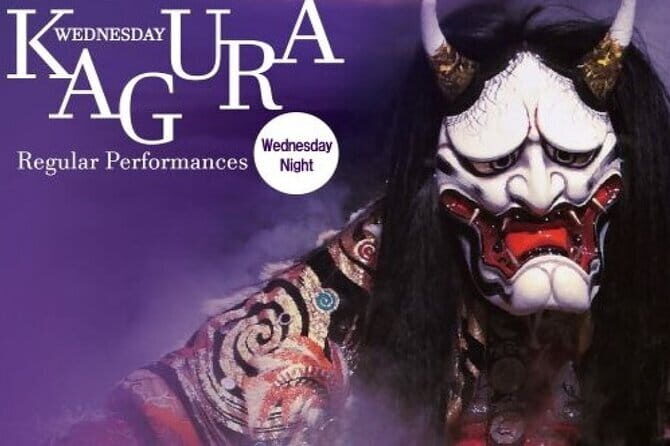
Hiroshima Kagura is a traditional performing art from Hiroshima Prefecture. The shows are inspired by Japanese mythology and classical literature, then expressed through dance, costumes, and music rather than through long speeches.
That matters for you, because the experience is designed to be understood through action. In the performance itself, spoken word is limited, so the rhythm of the music and the gestures do most of the storytelling. One handy touch: you’re provided with an English synopsis of the legend, and you also get English subtitles during the show.
Here’s what you should expect in practice:
- A troupe from Hiroshima Prefecture performs in a sequence that feels like one continuous narrative arc
- Live musicians provide the soundtrack in real time
- The performers rely on posture, turns, and stamping footwork to carry meaning
- The story support comes from subtitles and an English written outline, not from extended narration
If you’re worried you’ll be lost without Japanese, you probably won’t be. The show’s structure is the “translation,” and the English support fills in the gaps.
English Subtitles That Actually Help You Follow the Plot
This is one of the most praised parts of the whole experience: English subtitles are clearly provided and easy to use. Multiple accounts describe subtitles as excellent, and some note that they were easy to follow, even when spoken dialogue was sparse.
You’ll also hear an explanation at the start that sets up what you’re about to see. That helps a lot. When you know the legend’s basics before the first costume change, you can watch the performance without constantly checking your phone.
In short, the English support isn’t an afterthought. It’s built into how the show is presented. For me, that’s what turns Kagura from a “cool cultural spectacle” into something you can actually understand while you’re watching.
Also, if you want to take photos: at least one account notes that photography and even short videos were allowed during the performance, while another highlights photos at the end. Rules can vary by venue or show, so keep your camera ready, but follow any instructions from staff.
Costumes and Choreography: The Visual Payoff
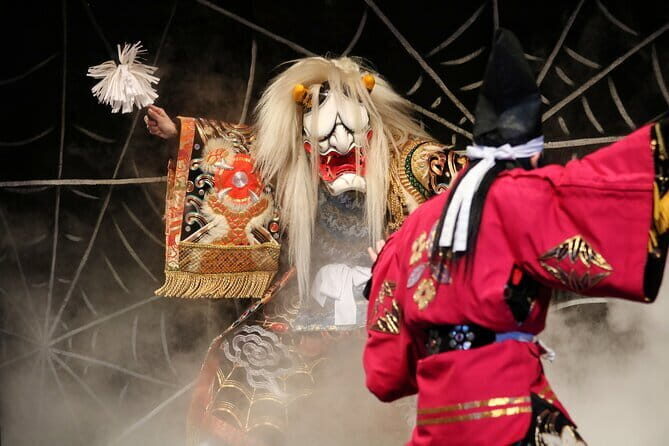
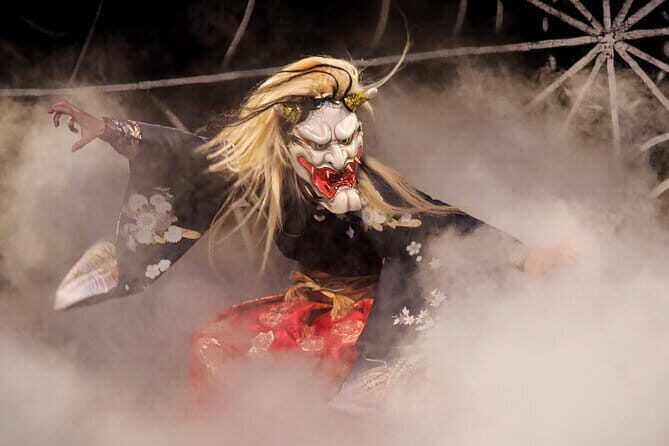
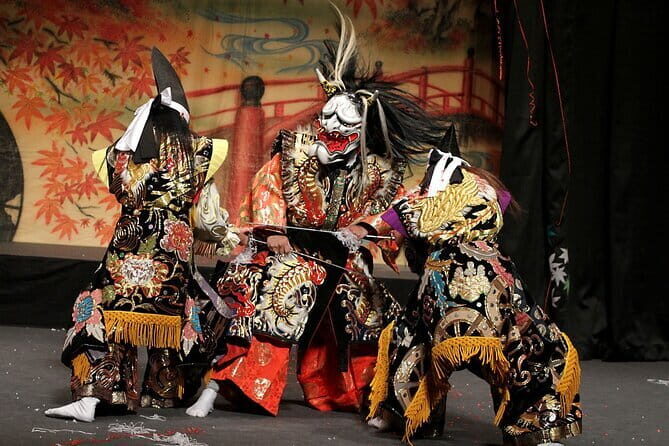
Kagura’s costumes are a major reason to book this. The outfits are described as intricate, colorful, and visually striking. Some costumes look heavy, and you can see it in how the performers control their movement. The choreography includes energetic jumps and fast turns, with a focus on precision as much as drama.
What I like about this is that the beauty isn’t just aesthetic. Costumes shape what you notice:
- Headpieces and masks make faces and expressions harder to read normally—so the body language carries more weight
- Layered garments change how the movement looks during spins and twirls
- The choreography highlights rhythm through patterned motion, not just random dancing
If you’re the type who likes to watch for details—how costumes move, how performers land, how musicians sync—this is genuinely fun. You’ll probably keep your eyes on the performers’ footwork and their transitions, not only the biggest moments.
Viewing Setup and How to Get a Good Seat
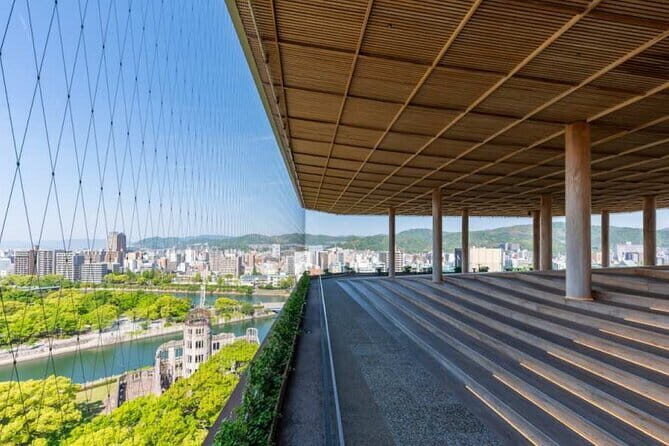
The venue uses seating that’s set up for viewing from multiple angles, and several accounts mention amphitheater-style sightlines with sloping steps. That’s good news: you’re less likely to be blocked, even if you’re not in the front row.
Still, do yourself a favor and arrive a bit early. Even with good sightlines, early seating generally means a clearer view of the performers’ faces and costume details—especially around the moments when they shift positions.
Practical tip: staff guide you where to sit, so once you’re inside, listen for instructions and get settled quickly. If lockers are available, that’s a helpful add-on if you’re carrying day-trip bags.
A few more Hiroshima tours and experiences worth a look
After the Show: Photos, Costume Try-Ons, and Interaction
What makes this experience feel more personal is what happens after the dancing.
Depending on the format and any add-ons, you can:
- Take commemorative photos after the performance
- Try on costumes and masks
- Ask questions directly to performers in the setting that’s offered after the show
Many accounts highlight the post-show picture opportunities. One review even notes that costumes and masks are fun to try on, and another calls out the interactive element as a key reason to go.
Now, here’s the honest consideration: post-show photos can move quickly. One account mentions the photos were taken in a line without much time to talk directly. So if your main goal is conversation, the optional backstage experience may be the better path.
Either way, the “after” part turns Kagura from a one-and-done performance into a night with a stronger personal memory.
Backstage Add-On: Worth It for Deeper Questions
Backstage tours are available after the performance for an additional fee. They’re described as including explanations from the performers and a chance to interact—often with opportunities to try costumes and ask questions once the dancing is done.
I’d frame the value this way:
- If you want a quick cultural show in English support, the regular ticket is already a strong deal.
- If you specifically want to ask questions and learn more about what you’re seeing, backstage is where that happens.
There’s one thing to keep in mind: one account notes that backstage photos and interaction can be time-limited, and performers may not speak English during that portion. So if you’re hoping for a long back-and-forth conversation in English, adjust expectations and focus on what you can communicate through questions, body language, and whatever translation support is provided on-site.
Price, Timing, and What This Is Really Best For
For $11.86, you’re paying for a live cultural show with English subtitles and an English story outline. That’s rare at this price point. You’re not just buying a ticket to watch movement—you’re buying something that helps you understand the story while it’s happening.
The timing is also a big part of the value. A 7:00 pm start means you don’t have to plan your day around an early morning or an awkward time slot.
This experience is especially good for:
- First-time visitors to Hiroshima who want one memorable cultural event without heavy planning
- Anyone who likes short performances that still feel meaningful
- People who want English support rather than hoping to figure everything out alone
- Families or mixed-age groups (the pacing is typically easy to manage because the show is under an hour)
If you’re craving a long, lecture-style museum experience, Kagura won’t replace that. But as a live performance with immediate payoff, it’s hard to beat for the money.
Should You Book Hiroshima Kagura?
Yes, if you want a high-impact cultural performance with practical English support and a low price tag. I’d especially recommend it if you like dance, costumes, and live music, and you want to understand what you’re watching without studying beforehand.
Consider the add-on if you’re the type who asks questions and wants a closer look after the show. Just know that interaction may be brief, and not every moment will be fully in English.
Skip it only if you need a long show, lots of spoken explanations, or you’re looking for a major time investment. With Kagura’s short runtime, you’ll leave with a strong impression—and you’ll still have plenty of time for Hiroshima after.
FAQ
Where does the performance take place?
It takes place at the Hiroshima Prefectural Citizen’s Culture Center in Hiroshima (1-chōme-5-3 Ōtemachi, Naka Ward).
What time does Hiroshima Kagura start?
The start time is 7:00 pm.
How long is the performance?
The duration is about 1 hour (approx.).
Is the admission ticket included?
Yes. Admission tickets are included in the experience.
Is there English support during the show?
Yes. English subtitles are available, and there is also an English synopsis of the legend.
Is a backstage tour included?
No. Backstage tours are offered occasionally after the performance, but they require an additional fee.
Are photos allowed?
Some accounts mention that post-show photos are part of the experience. One account also notes that photography and short videos were allowed during the performance, following on-site rules.
Do I need private transportation?
No. Private transportation is not included.
Can I cancel for free?
Yes. Free cancellation is available up to 24 hours before the experience’s start time for a full refund.
Are service animals allowed?
Yes. Service animals are allowed.